

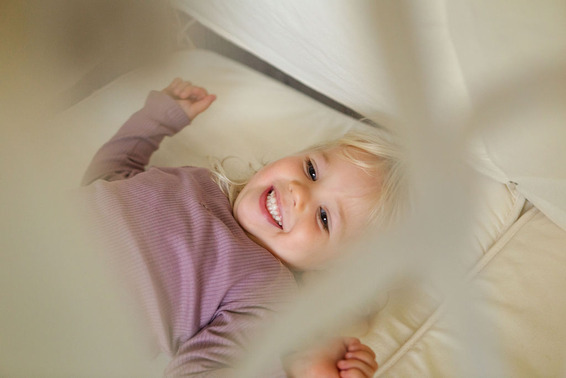
Guiding development
How we guide development
1. Observe first, then act
For us, guidance begins with careful observation and listening. We pay attention to emotions, body language, initiative in play, reactions to others and moments of calm or tension. These observations form the most important basis: a warm, close bond between the child and the educational professional.
Only when that sense of security is there do we choose how to connect:
- giving space to discover for themselves,
- gently inviting them to try new games,
- playing along to add language,
- setting boundaries when necessary,
- or simply doing nothing and waiting.
This approach to guidance stems directly from our principles of sensitive responsiveness and tailored action.
2. Guiding development through interaction
Our educational professionals work according to six educational interaction skills from our policy. This determines how we support development on a daily basis:
- Responding sensitively → seeing signals, recognising emotions.
- Respecting autonomy → giving time to try things for themselves.
- Structure and clarity → predictability and calm.
- Guiding interactions → putting social situations into words.
- Stimulating development → offering appropriate challenges.
- Talking and explaining → giving meaning to experiences.
These skills make our actions clear, warm and purposeful, exactly what young and older children need to grow.
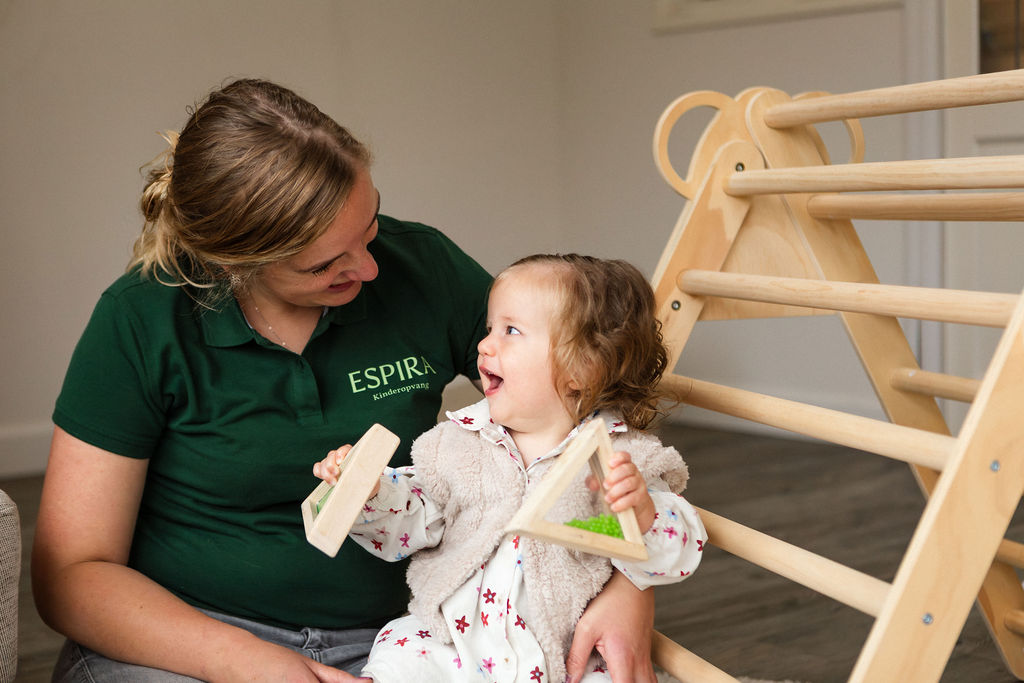
Observe
Observation and the child monitoring system
We monitor children's development in a conscious and structured manner:
- daily by observing their play and behavior;
- at fixed times through extensive observations;
- recorded in our child monitoring system, as described in our educational policy and work plan.
We pay attention to aspects such as: well-being, language, motor skills, play development, social skills, independence, and concentration.
We use the observations to:
- adapt materials, activities, and challenges;
- provide calmness where necessary;
- identify issues at an early stage;
- engage in targeted discussions with parents.
Mentor
The role of the mentor
Each child has their own mentor. A familiar face that the child knows really well. The mentor:
- closely monitors the child's development,
- discusses any concerns with the team,
- prepares development meetings,
- coordinates with parents,
- and ensures a smooth transition to after-school care or school.
For after-school care children, the mentor focuses primarily on social growth, well-being, self-confidence, and role in the group.
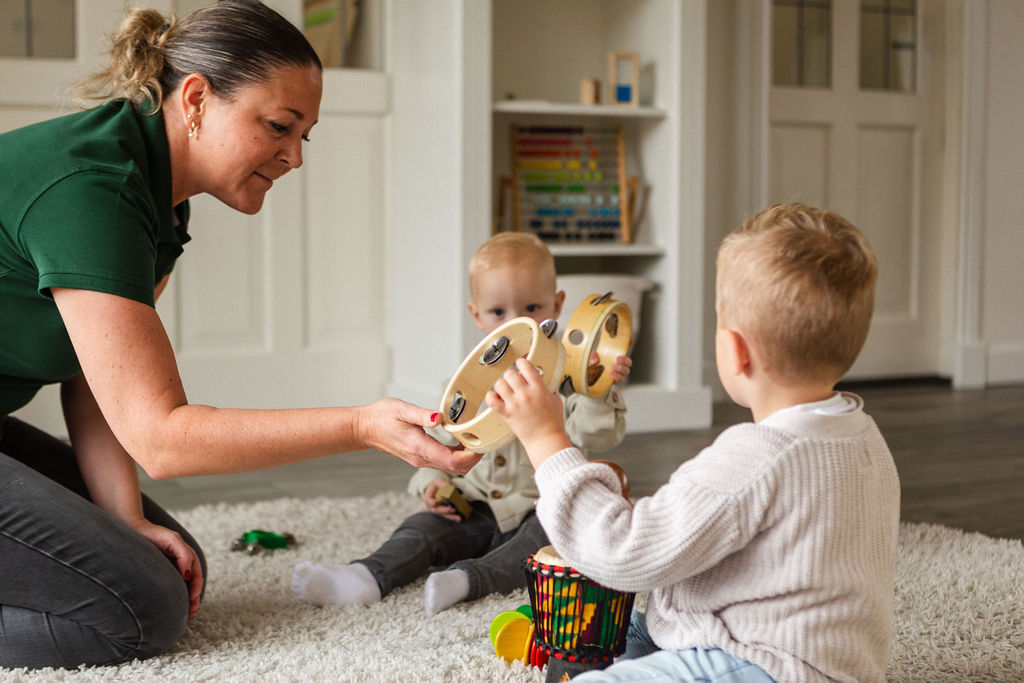
For children aged 0–4 years
Specifically for daycare centers
At the daycare center, the emphasis is on bonding, sensory discovery, and broad development. The group and the professionals form a safe base from which children dare to explore.
This is how we guide development at the daycare center:
- We use care moments as warm one-on-one moments for attention, language, and security.
- We pay attention to over- and under-stimulation and adjust the environment, lighting, materials, and pace accordingly.
- We stimulate curiosity with rich experiences:
- a baby feeling soft and hard materials;
- a toddler discovering sounds, shadows, and water;
- a preschooler sorting leaves or watching mud change.
- We offer age-appropriate activities within themes, so that children recognize and deepen their experiences.
- We build development in steps: first feeling and exploring, then moving and experimenting, followed by interaction, language, expression, and imagination.
The observations and conversations always form the compass for providing tailored guidance.
For children aged 4 to 12 years
Specifically for after-school care
At the after-school care center, we mainly focus on independence, social skills, and ownership.
We look at:
- how children organize their time;
- what choices they make and how they work together;
- how they set boundaries and deal with conflicts;
- when they are ready for new steps or challenges.
Professionals consciously observe from a distance and only intervene when necessary. They support children in organizing activities, making their own plans, and taking responsibility. This strengthens self-confidence and group skills.
For children who come from the daycare center, we build on what we have seen before. This creates a continuous learning path from 0 to 12 years old.
Identify
If there are additional concerns
When we identify that a child needs more support, we follow our care protocol: first observe, then consult internally, then discuss carefully with parents and—with permission—involve experts where necessary, such as our educational coach, CJG, speech therapy, or physical therapy.
Always with the same goal: working together to ensure that your child feels comfortable and can develop optimally.